
Welcome to the CARBONATURE Knowledge Hub. Whether you are a farmer looking to generate a new, sustainable green revenue stream or a corporate sustainability leader striving to meet ambitious Net Zero climate targets, understanding the mechanics of carbon farming is essential. Explore the science, markets, and methodologies behind REGEN-Ag, and discover how we turn verifiable climate action into high-integrity carbon assets.
The Ground Beneath Your Feet is a Climate Solution.
Agricultural soils are the second-largest carbon sink on the planet, capable of holding more carbon than the atmosphere and all plant life combined. However, decades of conventional, intensive farming have depleted this natural reservoir, releasing stored carbon back into the atmosphere.
Carbon farming reverses this trend. By optimizing agricultural management, farms can naturally draw down atmospheric CO2 and store it underground as Soil Organic Carbon (SOC). This process not only revitalizes the earth but transforms agricultural land into a highly valuable, measurable economic asset. For farmers, this untapped asset translates directly into a continuous green revenue stream financed by global carbon markets.
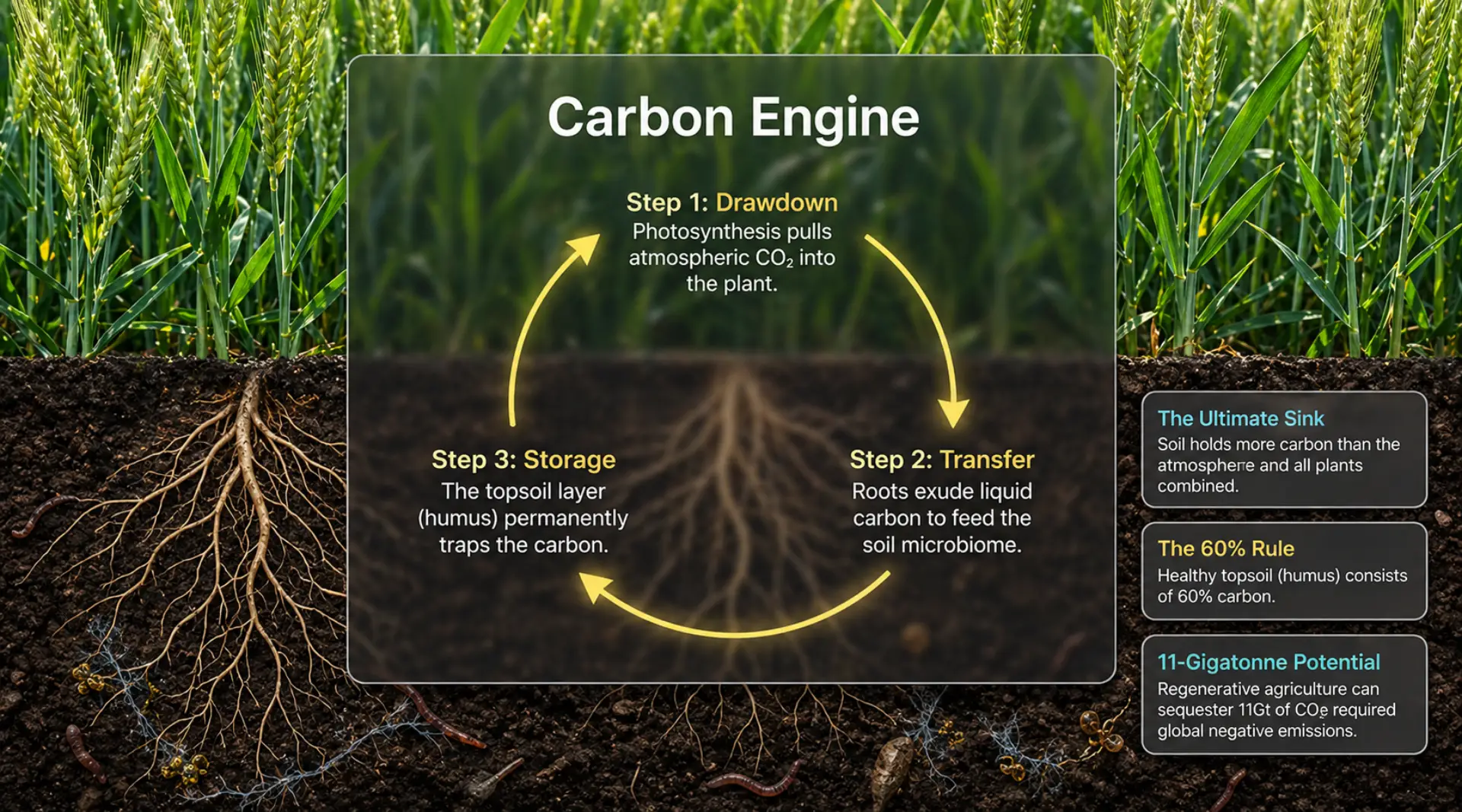
REGEN-Ag is a holistic approach focused on restoring soil health, rebuilding organic matter, and increasing biodiversity. But to generate financial value, these agronomic practices must produce verifiable climate impact.
When farmers implement specific regenerative interventions, they generate measurable carbon outcomes (either emission reductions or carbon removals). To qualify for carbon credits, these practices must demonstrate additionality, meaning the environmental benefits would not have occurred without the intervention and the financial incentive of the carbon market. Key regenerative practices that drive these outcomes include:
Minimizing soil disturbance to prevent the release of stored carbon.
Replacing synthetic nitrogen with biological fertilizers to drastically reduce nitrous oxide (N2O) emissions.
Keeping soils covered to enhance CO2 drawdown and protect against erosion.
In the carbon market, integrity is everything. Corporate buyers and regulatory bodies require absolute certainty that every ton of carbon claimed is real and scientifically validated. This is achieved through rigorous MRV (Monitoring, Reporting, and Verification).
The MRV process relies on precise data collection, from baseline soil sampling (using accredited partners like Cropnuts) to satellite tracking and AI-driven platforms. Through this strict scientific framework governed by carbon standard bodies like VERRA, Gold standard we ensure:
Establishing a clear historical emissions profile to measure future improvements against.
Ensuring that the sequestered carbon remains locked in the soil for the long term, protected by multi-year contracts and buffer pools.
Guaranteeing that reducing emissions on one farm doesn’t simply shift the emissions or deforestation to another location.
While carbon sequestration is the primary metric for global climate finance, the transition to REGEN-Ag delivers profound agronomic and ecological “co-benefits” that are equally vital to farmers and supply chains.
Healthier soils lead to better nutrient cycling and sustained crop productivity.
Increased soil organic matter drastically improves water retention, shielding crops against droughts and extreme weather.
Regenerative systems support local wildlife and beneficial microorganisms, creating a thriving, balanced ecosystem.
For ESG and Sustainability managers, understanding the landscape of carbon trading is critical for compliance and corporate strategy.
There are two primary mechanisms globally:
These are heavily regulated, government-mandated systems (like Cap-and-Trade programs) where specific high-polluting industries are legally required to limit their emissions or purchase allowances.
This market is driven by corporate climate commitments rather than legal mandates. Companies voluntarily purchase high-integrity carbon credits to offset their unavoidable emissions or meet ESG goals. The VCM provides the flexibility and scale needed to finance nature-based solutions, making it the primary engine driving agricultural carbon farming today.
CARBONATURE offers two distinct mechanisms to connect regenerative farming with climate finance, depending on your organizational boundaries and Net Zero strategy:
Purchasing premium, external, nature-based carbon credits to compensate for corporate emissions and meet broad ESG targets.
Directly decarbonizing your own agricultural supply chain (Scope 3) to achieve absolute compliance with SBTi FLAG mandates.
Offsetting involves buying carbon credits from verified carbon offset projects outside of your company’s value chain to compensate for your emissions. Insetting focuses on reducing emissions and increasing carbon removals directly within your own supply chain (e.g., a food brand investing in regenerative practices at the farms where they source their raw materials).
We use a rigorous MRV (Monitoring, Reporting, and Verification) approach. This combines primary ground-truth data, such as physical soil sampling analysed by accredited labs like Cropnuts to track changes in Soil Organic Carbon (SOC) and greenhouse gas emissions over time.
Additionality is a core requirement for issuing carbon credits. It proves that the emission reductions or carbon removals are additional to what would have happened in a “business-as-usual” scenario, and that the transition to regenerative practices was made possible specifically because of the intervention and participation in carbon farming project.
The primary risks are reversals (carbon being released back into the atmosphere, for example, due to deep tillage) and leakage (shifting emissions elsewhere). We manage these through strict compliance with VERRA methodologies, long-term monitoring contracts, hands-on agronomic support, and by contributing a percentage of credits to a global “buffer pool” to guarantee permanence.
For corporations, the Science Based Targets initiative (SBTi) FLAG guidance mandates that land-intensive companies reduce their specific Forest, Land, and Agriculture (FLAG) Scope 3 emissions. Carbon farming, deployed as an insetting strategy, provides the primary, audit-ready field data and verified Intervention Units (IUs) required to prove these reductions and meet SBTi targets.
To ensure the scientific integrity and permanence of the carbon stored, carbon farming projects are multi-year commitments. While specific durations vary by methodology, the Monitoring, Reporting, and Verification (MRV) cycles are designed to provide farmers with a long-term, predictable revenue stream while assuring buyers of lasting climate impact.
For the Farmer, the value lies in improving crop resilience, boosting soil health, and unlocking a completely new, sustainable financial revenue stream from their land with zero upfront costs. For the Corporate Buyer, the value is securing high-integrity, verifiable climate assets (credits or insets) to legitimately meet Net Zero mandates, shield against greenwashing, and build a resilient supply chain.
Whether you are a grower looking to generate green revenue or a corporate leader aiming to achieve absolute ESG compliance, our experts are here to guide you.

Select a time for